
Coastal Sage Scrub Habitat at Abalone Cove Shoreline Park near UCLA's South Bay Campus.
Southern California’s Native Coastal Sage Scrub and Chaparral Habitats
Here in SoCal, two native habitats once predominated the natural landscape: Coastal Sage Scrub and Chaparral. Both are characterized by their fragrant, shrubby plant life and by the prevalence of small mammals, local and migratory birds, and many unique insects. Though these two habitats share many similarities in terms of climate and native species, they are differentiated primarily by their proximity to the Pacific Ocean. Coastal Sage Scrub often lies directly on Southern California’s coastline, while Chaparral lies a bit more inland.
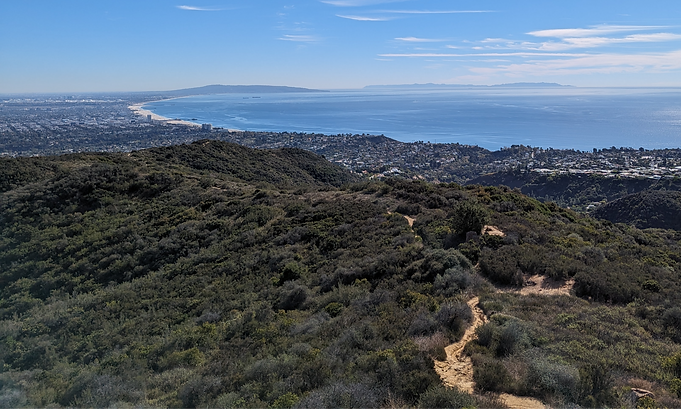
However, over the course of human development in SoCal, these native habitats have been relegated to very small pockets, their range being severely diminished from its past prominence. Not only have they been displaced by the construction of suburbs, highways, and stroads, these CA habitats also face the pressures of invasive species, many brought here by European colonizers during California’s tragic, violent colonial period.
Chaparral Habitat in Topanga State Park near UCLA's main campus.
Foraging for Invasives as a Means of Conservation
Invasives, non-native plants which detrimentally impact native ones, grow abundantly on most California trails, especially during the rainy season, and they outcompete native plants, leading to monocultures of invasives like black mustard spreading across the state’s hillsides. By finding ways to consume these plants via foraging, perhaps, as individuals, we can have a small impact on the problem of invasives.

Black mustard on a hillside in Portuguese Bend Reserve near UCLA's South Bay campus.
Some tips for collecting invasives:
-
Be sure to know your local laws before collecting. Some preserve lands ban unauthorized take of any species, native or not.
-
Don’t collect near roadways and other sources of contaminants. Make sure that you never collect plants when you are unsure of their safety.
-
To collect larger volumes, think about volunteering to remove invasive plants with a local conservancy or non-profit. They will most likely let you take home as many trimmings as you’d like.

Black mustard on a hillside in Malaga Canyon Reserve near UCLA's South Bay campus.
While foraging, make sure you know for sure what the plant is before eating it. Never eat a plant when you are unsure of its identity. Do not go foraging for your first few times alone. One of the most impactful lessons for collecting plants for consumption is watching a more experienced forager actually pick and eat the plant themselves.
For information about foraging classes in the Los Angeles area, visit: https://www.meetup.com/find/us--ca--los-angeles/foraging/


Black Mustard (Brassica nigra)
Black mustard, a perennial weed that can grow up to 8-10 feet tall, can be found just about everywhere across California due to its noxious qualities. Though the story is unconfirmed, it is thought to have been brought to the state and intentionally spread by Spanish colonizers as a means to mark the paths throughout the mission system.
The young, smooth leaves of black mustard can be eaten raw, and they have a horseradish-like spice, depending on the time and location of harvest. Additionally, the larger, hairy leaves as well as the young flower buds (which have not yet produced pollen) can be cooked and eaten.


Fennel (Foeniculum vulgare)
Fennel, like black mustard, is a highly invasive weed that ranges across the state of California. When the leaves are crushed, the plant exudes a strong smell of licorice. As for its introduction into the natural environment of CA, Fennel is thought to have escaped from the spice garden of a Spanish missionary.
Fennel is an extremely popular plant used most famously in Italian food, and every part of the plant is technically edible. The dry seeds can be harvested and ground to produce a commonly used spice, or they can be roasted whole and added to meat, like sausages. The leaves can also be used as a garnish for salads, soups, and other dishes (keep in mind that fennel is highly fragrant). Among these, there are dozens of other uses of the plant, due to its widespread popularity for culinary activities.
Garden Nasturtium (Tropaeolum majus)
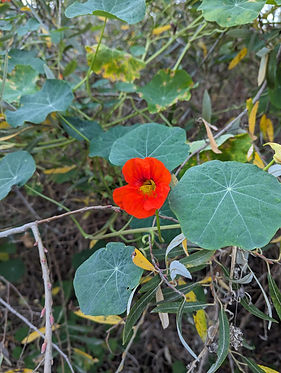
Though less detrimental to native species than black mustard and fennel, garden nasturtium is another prevalent invasive found all across California. Sometimes called monk’s blossom, the plant is characterized by bright red-orange flowers and round, lily-pad shaped leaves.
Like fennel, the entire plant is edible. The flowers and leaves are the most commonly consumed and can be a delicious addition to bulk up a salad, with the flower being a lovely garnish. Some say that the peppery flavor reminds them of watercress, and the hotter the weather, the spicier it gets.
An Invasive Plant Recipe to Try:
Asian-style Stir-fried Mustard Greens
This recipe would likely work best as a side dish, accompanying something more substantial. I decided to try to make it as a snack, served with rice.
Ingredients:
A dollop of butter
A handful of mustard greens (younger green leaves between 2-4 inches)
A dash of soy sauce
A pinch of sugar
Salt and pepper to taste
1-2 garden nasturtium flowers for garnish
-
Wash your greens. Melt the butter in a medium-sized pan over medium-high heat, adding the greens once the butter starts to bubble.
-
Once the greens start to wilt, add the soy sauce, sugar, salt, and pepper to your liking.
-
Continue stir-frying for 1-2 more minutes.
-
Serve immediately with rice and a monk’s blossom garnish, if desired.


